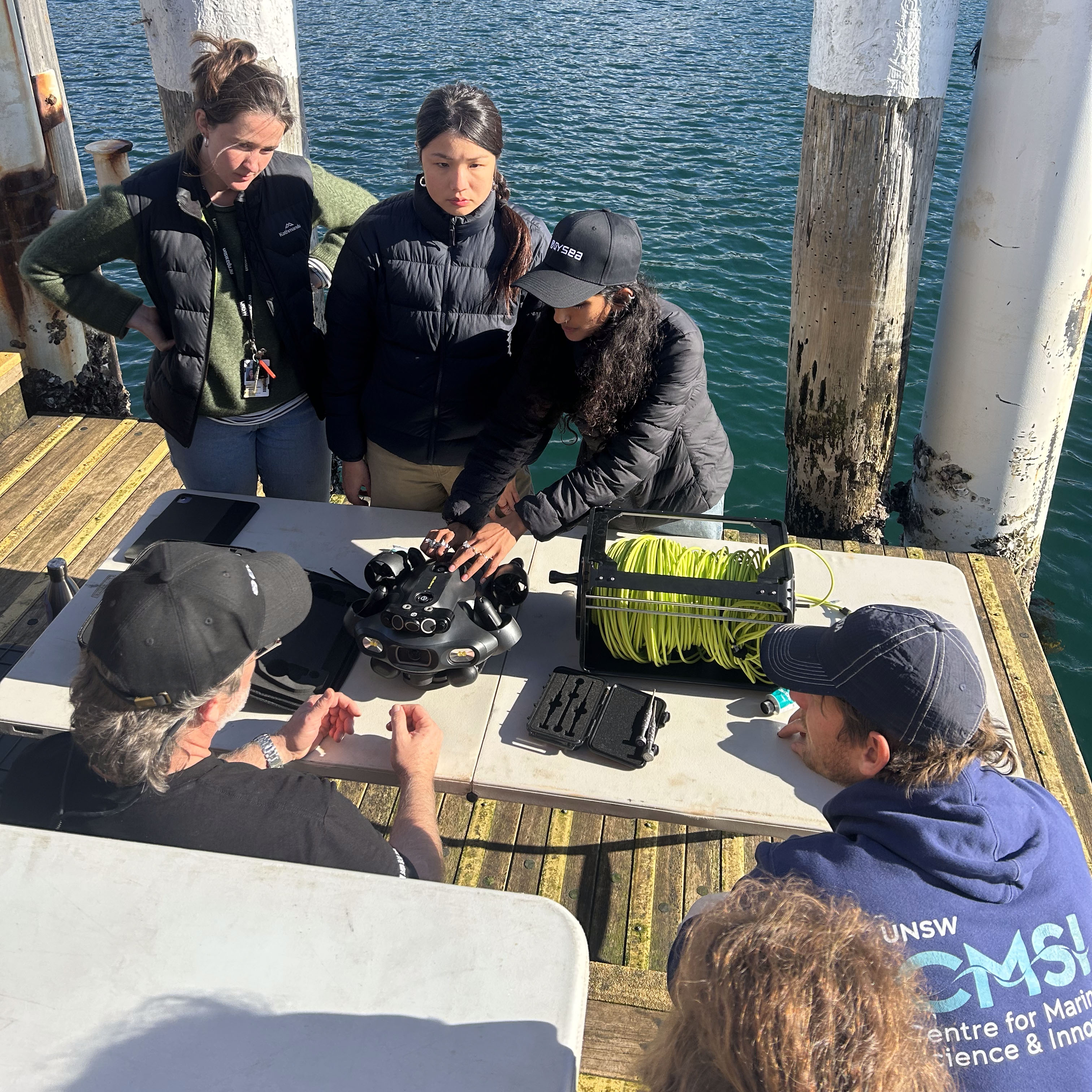
On 14 July 2026, Underwater Australasia delivered an advanced QYSEA E-Master ROV Operator Training Course for participants from the University of New South Wales (UNSW) and the Sydney Institute of Marine Science (SIMS) at the outstanding SIMS facilities in Chowder Bay, NSW.
The training combined comprehensive classroom instruction with practical field operations, equipping participants with the knowledge and confidence to safely deploy and operate professional underwater remotely operated vehicles (ROVs) for marine science, environmental monitoring and underwater inspection applications.

The morning theory sessions, conducted within SIMS' excellent lecture facilities, covered the complete lifecycle of professional ROV operations. Course modules included an introduction to ROV technology, underwater piloting techniques, tether management, pre-dive planning and safety procedures, post-dive operations, preventative maintenance, operational management and best-practice underwater data capture.
Participants were also introduced to several of QYSEA's latest technologies, including the new IP54-rated programmable Q-iRC controller, designed for demanding field environments, and QYSEA's U-INS (Underwater Inertial Navigation System), enabling precise underwater navigation where GPS signals are unavailable. The course also explored the advantages of integrating a Doppler Velocity Log (DVL) for highly accurate station holding, position estimation and repeatable survey operations, particularly valuable when conducting scientific transects and detailed infrastructure inspections. To further improve positional accuracy at the water's surface, participants learned how a GNSS locator beacon can be used to accurately geo-reference dive locations and underwater datasets, improving the quality and repeatability of long-term monitoring projects.

Following the classroom sessions, the group moved to the Chowder Bay wharf where participants carried out structured pre-dive inspections before deploying the QYSEA E-Master ROV into Sydney Harbour. Practical exercises focused on precision piloting, effective tether management, stable station holding using the DVL, underwater navigation and mission planning with U-INS, while gaining valuable experience operating the new Q-iRC controller in real-world conditions.

A significant component of the practical training centred on conducting scientific underwater transects, demonstrating how ROVs are increasingly being used to collect repeatable ecological monitoring data. Participants practised survey techniques for ascidian monitoring, crayweed habitat assessments, and broader marine biodiversity and environmental monitoring programs. The exercises highlighted the importance of consistent transect methodology, precise positioning and high-quality imagery for creating robust long-term scientific datasets.

The team also had the opportunity to experiment with a robotic grabber arm, evaluating its potential for non-destructive sample retrieval and underwater object recovery. Discussions explored future applications including biological specimen collection, marine debris removal, environmental sampling and the recovery of small equipment from the seabed, further demonstrating the versatility of modern inspection-class ROVs.
The practical sessions concluded with post-dive inspections, maintenance procedures and equipment care, reinforcing the importance of operational readiness and long-term equipment reliability.

Underwater Australasia would like to thank the teams from UNSW and SIMS for their enthusiastic participation and extend our sincere appreciation to SIMS for providing such exceptional teaching facilities and direct access to the waters of Sydney Harbour. As underwater robotics continues to transform marine research, environmental management and coastal monitoring, we are proud to support Australia's scientific community through specialised QYSEA E-Master ROV training, helping researchers harness advanced technologies including U-INS navigation, DVL positioning, GNSS geo-referencing, and robotic manipulation to collect more accurate, repeatable and scientifically valuable underwater data.
See the full Qysea range here and get in touch with us with any questions regarding any of the products.