
11 Sharks You Should Know About This Summer
Contributed by Wandy Hochgrebe
My sister and I were swimming in a quiet area of Jervis Bay on the east coast of Australia a few years back. Suddenly a fin cut through the water…another one appeared next to it and another and another. Moving fast, not towards us but very close. Sharks?
It turned out a pod of dolphins was cruising past and we were over the moon about having such a close encounter with these amazing mammals!
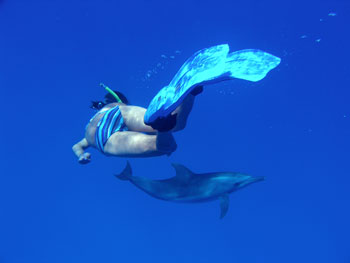 Since that day in Jervis Bay I
have voluntarily dived with many
different species of shark, including the giant Whalesharks, Hammerhead
Sharks, Grey Nurse Sharks, White-tip and Black-tip Reefsharks, Port
Jackson sharks, numerous wobbegongs and just recently I snorkelled up
close with a Lemon Shark. And guess what, at each occasion I actually
entered the water hoping I would be lucky enough to see sharks. I have
lived to tell the tale. And yes, all my limbs are still there, intact
and there wasn’t a moment I would have thought the outcome would be any
different.
Since that day in Jervis Bay I
have voluntarily dived with many
different species of shark, including the giant Whalesharks, Hammerhead
Sharks, Grey Nurse Sharks, White-tip and Black-tip Reefsharks, Port
Jackson sharks, numerous wobbegongs and just recently I snorkelled up
close with a Lemon Shark. And guess what, at each occasion I actually
entered the water hoping I would be lucky enough to see sharks. I have
lived to tell the tale. And yes, all my limbs are still there, intact
and there wasn’t a moment I would have thought the outcome would be any
different.
Plenty of people go through a lot of effort to dive or snorkel with Great White Sharks, Tiger and Bull Sharks - which are all considered to be dangerous to humans - in locations they are known to frequent. Snorkelling with Whalesharks, off Exmouth in Western Australia for example, is another well-known experience.
People are scared and fascinated at the same time by sharks and that comes a no surprise since shark live in a habitat that is relatively foreign to us and we are no where as gracious and fast moving as any animal living in the water. We are fairly restricted in our movements once we enter the water and can no longer touch the ground. In addition our vision is limited and once we are underwater for a while we will always have to come up to the surface where we bob around, helplessly. Sharks on the other hand are fast moving top-predators, fully adapted to their environment and mostly portrayed as indiscriminate killing machines. And a lot of their biology is still a big mystery to us land-dwelling mammals.
There are more than 400 known shark species worldwide of which about 160 species live in the waters surrounding Australia. Most shark species can be found in the relatively shallow continental shelf areas at a depth between 0 and 200 meters.
Sharks - and their close relatives rays and chimeras - have a skeleton that is build up from cartilage rather than the bony skeleton of mammals and other fish. All species are cold-blooded. Fortunately, only a few of those species are considered dangerous to people since on occasion their presence in the water has a bad outcome for the people.
All known sharks are carnivorous, which basically means they don’t like their vegies. Their diet might consist of large fish including other sharks or shellfish and for some occasionally garbage that is floating past.
Sharks have been around a long time and generally speaking have well-developed senses of sight and smell. Their hearing is very different to ours, but their internal ears can detect vibrations and differences in pressure. In addition they have the so-called Ampullae of Lorenzini located on their snout, which can detect fluctuations of the electrical fields in their surrounds. A combination of those senses is used in detecting and locating its prey.
Sharks come in a lot of different shapes and sizes. Sharks vary from looking like the classic shark such as the Great White Shark and the Bull Shark to something more friendly-looking like the Port Jackson or the Leopard Shark. The smallest shark known to man, the Small-eye Pymgy Shark, has been estimated to grow to a maximum length of 22 cm. The world’s largest shark, the Whaleshark, has been reliably reported to reach lengths of 15 meters.
Shark attacks in perspective
Any shark attack makes for a good story. Of course, any loss of human life or serious injury is a tragedy, but realistically your car trip to the beach carries a higher risk of being killed than you being killed by a shark once you get there and go for a swim or surf. And in the last 215 years of documenting shark-human incidents sharks have attacked less people than people killed by road crashes in Australia each year.
On average 1 person per year dies as a result of a shark attack in Australia compared to ~ 200 people per year who die due to accidental drowning, and ~ 1500 die in road crashes.
Personally, I get rather annoyed when another shark attack hits the headline and it turns out that someone has a bite on their arm after lifting a wobbegong shark out of the water by its tail.
Human Attacks in perspective
It is hard to say how many sharks are being killed by humans per year, but the number is in the millions – 100 million according to Sea Shepherd. Their population are indiscriminately depleted faster than they can reproduce. Two human actions stand out as being particularly cruel and unnecessary.
Shark finning is the practice of cutting off the fins of a shark. Shark fins are used in shark-fin soup or for traditional cures. Once the fins have been cut off, the shark still alive, wounded and helpless will be thrown back over-board and dies a slowly death as the shark is not able to swim. The rest of the shark is not valuable enough to justify transporting the relatively bulky shark body back to shore.
Besides the suffering of the individual sharks it has major consequences for the shark population, the marine eco system and loss of sharks as a food staple for many developing countries.
There are countries that have shark-finning legislation in place, even some that state the fins must be still attached, meaning it would be illegal to have only fins on-board.
According to Wikipedia a shark net is a submerged net placed around beaches to reduce shark attacks on swimmers. A common but debated practice in Australia. The Department of Primary Industry in NSW stated that the nets have never been regarded as a means of absolutely preventing any attacks, but help to deter sharks from establishing territories.
The nets are meant to capture sharks and prevent their escape until they eventually drown. But besides the sharks whales, turtles, dolphins, sea birds and even dugongs all die in beach nets too.
Getting to know sharks
As you start reading about sharks, visiting aquariums and maybe even snorkelling or diving with these amazing animals you might start to appreciate or even like them and the important role they have to play in the (marine) ecosystem. Therefore we listed 11 species that you could find in your own backyard so to speak with a little bit of info.
Great White Shark - Carcharodon carcharias

 Other common names for this
shark include White Shark, Great White, White Pointer and White Death.
An amazing powerful shark no doubt with refined senses to detect and
catch its prey. The main diet of the Great White Shark consists of fish
and smaller sharks. Only the larger individuals will have a go at seals
and dolphins.
Other common names for this
shark include White Shark, Great White, White Pointer and White Death.
An amazing powerful shark no doubt with refined senses to detect and
catch its prey. The main diet of the Great White Shark consists of fish
and smaller sharks. Only the larger individuals will have a go at seals
and dolphins.
The Great White Shark has a solid body, pointed nose and crescent-shaped tails. Its colour is slate grey with a bronze sheen on the top and white below. The eyes are black and round and the teeth are visible as the mouth is always slightly opened.
In Australia they are found from North-West Cape in Western Australia to the south of Queensland, but they are mainly seen off the coast of South Australia.
The maximum length of this shark is not really known, but the largest ever caught measured 6 meters. Trust me, this is an impressive shark at any size.
Considered dangerous to human.
*Image by underwater australasia member Daniel Norwood
Bull Shark - Carcharhinus leucas
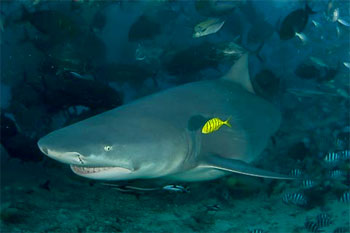 A resident Bull Shark can
regularly be seen at the Yongala Wreck, off Townsville and doesn’t seem
to pose a danger to the divers visiting this wreck. They are also
common at the shark feeding at Beqa Lagoon, Fiji with plenty of people
being very excited about the opportunity to be in the water with them.
A resident Bull Shark can
regularly be seen at the Yongala Wreck, off Townsville and doesn’t seem
to pose a danger to the divers visiting this wreck. They are also
common at the shark feeding at Beqa Lagoon, Fiji with plenty of people
being very excited about the opportunity to be in the water with them.
Bull Sharks are a more tropical shark and live all around northern Australia from Perth to Sydney. They prefer murky waters near the coast. Bull Sharks are also called River Shark or Freshwater Whaler due to their ability to live for extended time, and even breed, in fresh water and have been found kilometres upstream of large rivers.
Considered dangerous to human, especially since they are more likely to visit places where people swim.
*Image by underwater australasia member David Baxter
Tiger Shark - Galeocerdo cuvier
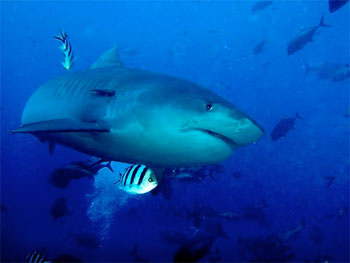 Tiger Sharks have a diverse
diet and are more opportunistic feeders
than the other large sharks and bizarre items have shown up in its
stomach contents. These sharks will go for both live prey and carrion.
However, sometimes they go for a more specific prey and timely show up
at areas near rookeries where young seabird learn to fly, at turtle
nesting areas etc and wait for dinner to drop in.
Tiger Sharks have a diverse
diet and are more opportunistic feeders
than the other large sharks and bizarre items have shown up in its
stomach contents. These sharks will go for both live prey and carrion.
However, sometimes they go for a more specific prey and timely show up
at areas near rookeries where young seabird learn to fly, at turtle
nesting areas etc and wait for dinner to drop in.
Tiger Sharks are a large species with a blunt, almost square, head and large black eyes set forward on the snout. Its back is grey with darker tiger-like grey stripes (hence the name), which sometimes fade completely when the animal gets older.
The Tiger Shark is common in the tropics and also occurs in temperate waters off the New South Wales and West Australia coast during summer. They hunt in harbours and around shallow reefs and are therefore more likely to encounter humans more often than the other species of dangerous sharks.
Tiger Sharks can reach a maximum length of 6 meters, but are usually between 3 - 5 meters.
Considered dangerous to humans.
*Image by underwater australasia member Iwona Krekora
Scalloped hammerhead - Sphyrna lewini
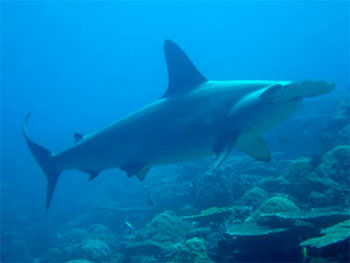 The Scalloped Hammerhead Shark
usually eats fish and squid, which they hunt for at night in the deeper
waters.
The Scalloped Hammerhead Shark
usually eats fish and squid, which they hunt for at night in the deeper
waters.
Their oddly-shaped head is thought to be more efficient at detecting electrical variations and helps the shark at swiftly turning when chasing their speedy prey.
This rather shy shark can sometimes be found in large schools.
Hammerhead Sharks are easily identified due to the distinct shape of their head. The Scalloped Hammerhead has several indents at the front of its snout. This shark has a grey-brown back and a lighter underside.
Scalloped Hammerhead sharks live all around northern Australia from Perth to Sydney. This shark species can reach a maximum length of 3.5 meters.
*Image by underwater australasia member Michael Roet
Grey Nurse Shark – Carcharias taurus
 The Grey Nurse Shark have
longish fork-like teeth that can easily
been seen even when their mouth is closed, making them look much more
scary than they really are. These teeth are being used to catch their
prey such as fish and small sharks and rays.
The Grey Nurse Shark have
longish fork-like teeth that can easily
been seen even when their mouth is closed, making them look much more
scary than they really are. These teeth are being used to catch their
prey such as fish and small sharks and rays.
Known also as the Sandtiger Shark this species was long thought to be a ferocious man-eater. Many of these sharks were killed during the 1950 – 60s until it was realised that Grey Nurse Sharks very rarely attack humans and only when they are cornered or when people carry dead fish around their waist.
Grey Nurse Sharks have a bronze coloured back, a pale belly and a pointy snout with their teeth protruding. Some have darker spots on their sides, which always remind me of freckles, although I doubt they do a lot of sunbaking.
In Australia they can be found from Southern Queensland down to south New South Wales on the east coast and in the South West of Western Australia. They migrate to the relative warmer waters in winter.
The Grey Nurse Shark is considered critically endangered on the east coast of Australia and is a protected species.
Grey Nurse Sharks can grow to 3.2 meters.
Spotted Wobbegong – Orectolobus maculatus
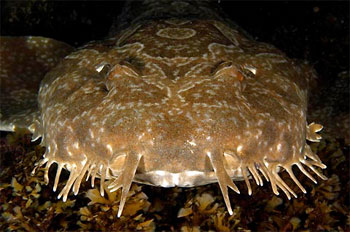 Wobbegong Sharks are pretty
common in Australia and there are 4
different species that can be found here: Ornate Wobbegong, Spotted
Wobbegong, Tasselled Wobbegong and the Dwarf Ornate Wobbegong.
Wobbegong Sharks are pretty
common in Australia and there are 4
different species that can be found here: Ornate Wobbegong, Spotted
Wobbegong, Tasselled Wobbegong and the Dwarf Ornate Wobbegong.
The word 'Wobbegong' believed to come from an Australian Aboriginal language, meaning 'shaggy beard' referring to the branched lobes around the mouth, according to Wikipedia.
Their mottled, camouflaged appearance, flattened head, frilly appendages at their mouth and the fact they lie motionless underneath rocks earned them the alternative name of carpet shark. Although the individual species are easily confused you would not mistake them for any other shark due to their unique appearance.
The Spotted Wobbegong mainly feeds at night and feeds on fishes, crayfish, crabs and octopuses.
This Wobbegong is the largest species of the Australian Wobbegongs and with its maximum length of about 3 meters it is an impressive sight to see a large one swim past or even towards you! Spotted Wobbegongs are mottled brown and yellow with distinct circles of small white spots.
The Spotted Wobbegong occurs along the southern coastline of Australia from southern Queensland to south-western Western Australia and is probably unique to Australia (endemic).
All wobbegong sharks can look ridiculously docile, but do not try to pick them up oklpi09or pull their tail! This shark is able to turn 180 degrees in a flash even if you manage to hold on to their tail. Their bite can be serious as they have plenty of sharp teeth to hold on with.
Whale Shark - Rhincodon typus
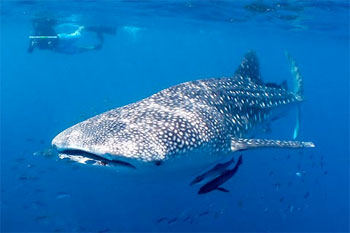 The largest fish in the ocean
hunts by opening its large mouth and swallowing everything that gets
stuck inside. Plenty of plankton gets caught in sieve-like gill rakers,
but schools of fish can also get stuck in its mouth and even the odd
small tuna or squid make their way inside.
The largest fish in the ocean
hunts by opening its large mouth and swallowing everything that gets
stuck inside. Plenty of plankton gets caught in sieve-like gill rakers,
but schools of fish can also get stuck in its mouth and even the odd
small tuna or squid make their way inside.
Whale Sharks are very easily recognised due to the sheer size. Its back
and sides are covered by a checker-board pattern of dots and lines. The
head is blunt.
The pattern on a Whale Shark is unique to the animal and researchers
are using those patterns for identification and tracking of individual
Whale Sharks.
Whale Sharks are found in tropical seas all around the world and may be
seen all around northern Australia from Perth to Bass Strait. Generally
people encounter them when they are swimming and/or feeding near the
water’s surface.
Every year from March until the beginning of July Whale Sharks migrate
past Exmouth in Western Australia and people have the opportunity to
snorkel along side. Strict rules apply as to not harass the animals,
but also to avoid people getting hurt by this gentle giant.
Most Whale Sharks are 4 – 12 meters long, but the largest Whaleshark
that has been caught was documented
as being 12.6 meters long and have a girth of 7 meters!
*Image by underwater australasia member Daniel Norwood
Leopard Shark – Stegostoma fasciatum
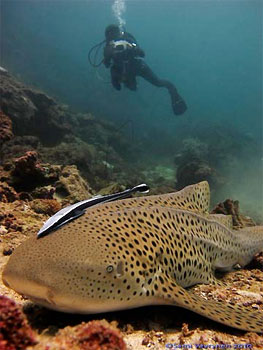 The Leopard Shark is another
shark species you do no have to be afraid of. They can often be found
resting on a sandy patch and can easily be approached.
The Leopard Shark is another
shark species you do no have to be afraid of. They can often be found
resting on a sandy patch and can easily be approached.
These sharks feed mainly on shellfish as well as shrimp and small
fishes.
The adult animals feature leopard-like spots on top of their body and
the top of its tailfin has the same length as its body. The juvenile
ones feature a striped pattern hence the alternate name of Zebra Shark.
The Leopard Shark has a blunt head and very small eyes.
This shark prefers warmer waters of 22°C and up and normally can be
seen in the warmer waters on shallow reefs from Carnarvon, Western
Australia to Sydney.
The Leopard Sharks can reach a maximum size of 2.5 meters.
Grey Reef Shark – Carcharhinus amblyrhynchos
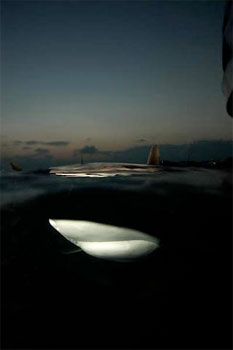
The Grey Reef Shark or Grey Whaler Shark has sharply pointed but
small teeth. They mainly eat small reef fishes and occasionally squids
or crayfish.
When threatened, Grey Reef Sharks will perform a threat display with a
hunched back dropped pectoral fins and an exaggerated side-to-side
swimming motion- a sure sign to leave it alone. They do give quick
warning bites, but are not usually thought to be a threat to humans.
This shark can be recognised by its shark-like appearance and a black
edge on the V-shaped tailfin, hence the other common name of Black-vee
Whaler. The back is bronze or grey and it has a pale belly.
Grey Reef Sharks are commonly seen on the Great Barrier Reef by divers
and snorkelers and can be found on coral reefs, near deeper water in
northern Australia from Carnarvon to Bundaberg.
Grey Reefies can theoretically reach a length of 2.5 meters, but most
of them are just under 2 meters.
Whitetip Reef Shark – Triaenodon obesus
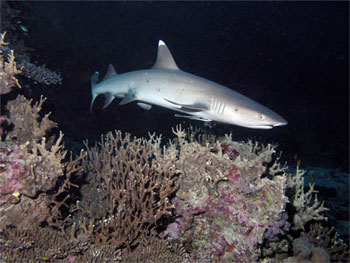 This common reef shark hunts
mainly at night in groups and go for small reef fishes, octopus,
cuttlefish, but also crab and lobsters.
This common reef shark hunts
mainly at night in groups and go for small reef fishes, octopus,
cuttlefish, but also crab and lobsters.
Most people are comfortable with seeing a Whitetip Reef Shark on their
dive or snorkel trip on a coral reef. These sharks are very slender,
torpedo-like and have, as their name implies, white-tipped dorsal fins
and tailfin.
Quite often they can be seen lying underneath coral heads or in small
caves or swimming near the ocean floor.
Whitetip Reef Sharks are very common on reefs all around northern
Australia from West Cape to Gladstone. This fairly small shark can
reach a maximum length of 1.7 meters.
Port Jackson Shark – Heterodontus portusjacksoni
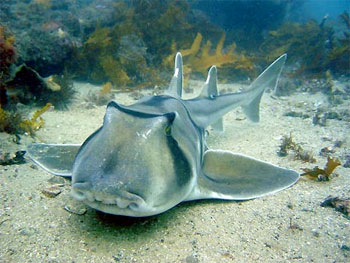 Port Jackson Sharks feed at
night on a variety of bottom dwelling animals and likes sea urchins and
sea stars.
Port Jackson Sharks feed at
night on a variety of bottom dwelling animals and likes sea urchins and
sea stars.
Although this shark would not attack humans care should be taken if you would ever see the need to be handling this shark as a poisonous spine sits just in front of its dorsal fins.
This somewhat odd looking shark is pale-brown with a dark brown harness-shaped pattern on its back. Its head is blunt with bony ridges above the eyes.
Although its name implies it is only found in Sydney’s Harbour the Port Jackson Shark can be found all around southern Australia between Carnarvon, Western Australia and Tweed Heads, New South Wales
Port Jackson Sharks are only small and reach a maximum size of 1.6 meters, but are generally much smaller – around the 1.3 meters.
FAQ
When do the sharks come out to play? Ie. is there a certain time you should avoid the water?
Most attacks world-wide happen between 8.00 am and 6.00 pm and mostly on weekend during the warmer seasons of the year. This has not so much to do with shark behaviour though but everything with human behaviour since these are the times when most people are spending time in the water.
Sharks will generally hunt at dawn and dusk and at night, but like many predators will feed at any time they come across prey unless they have just eaten and some female sharks – like the female Grey Nurse Sharks – don not eat at all during mating season.
What do I do if I see a shark while I’m swimming?
If you are not sure of the species or intention of the shark you should calmly, quietly and quickly leave the water. However, if it is for example a Leopard Shark, a Port Jackson Shark or a White-tip Reefshark you might consider getting your camera out and take a few shots. In any case treat it with respect and don’t try to pick it up or prod it.
How can I tell which sharks are dangerous, and which are harmless?
There are several species that can inflict injury when they are provoked or harassed, but only 4 species are considered to be truly dangerous: Tiger Shark, Bull Shark, Great White Shark and Oceanic White-tip
This has to do with their world-wide distribution as these species can be found in many places, size and choice of natural prey. And lets be realistic no-one is reporting the fact they were nibbled on by a Small-eye Pygmy Shark (maximum size recorded 22 cm) and it would be unlikely too since they live at a depth of 2000 – 200 m.
Even so there are times that swimming with even those sharks can be safe and many people have encountered those sharks unexpectedly and were fine. However, it is recommended to leave the water.
There are many theories why sharks attack or injure people and no one really knows. A few theories include mistaken identity with a prey animal, being curious and using their tasting organs located in their mouth to check or they attack when they feeling threatened or cornered.
Harmless sharks would include species such as the Port Jackson Shark, Leopard Shark, Blind Sharks and most smaller shark species. However, as with all animal – wild ones in particular - sharks that are cornered, harassed or threatened can respond unpredictably.
What do I do if I get attacked by a shark? (eg. have heard you kick it between the eyes – is this true?)
Various strategies can be found on how
to ‘fight’ a shark in books and on the web. Logic tells us that indeed
it would be sensible to go for areas that are most sensitive such as
the snout where the ampullae of Lorenzini are located, the eyes or the
gills. While you are at it pull its claspers if it is a male.
Practically, would you really be able to reach those spots whilst you
are being attacked?
In any case it is not recommended to play dead but instead fight for
your life and find anything hard or sharp to hit or stab the shark
wherever your can. If a shark bumps you and swims off you should
quickly, but calmly (?!) exit the water trying to keep facing the
shark. When SCUBA diving and you have enough air find a spot with your
back against a solid surface or back-to-back with your buddy and try to
get back to shore or the boat. If you are being injured or hurt seek
immediate medical assistance even if it does not seem serious at the
time.
Is it true that if I wear a black wetsuit, sharks will think I’m a seal and are more likely to attack me?
A lot of wetsuits people wear tend to be a darker colour and looking up from down below against the light anything on the surface looks dark anyway. Shark experts also believe that sharks make up their mind on where to go long before they have visual contact.
As mentioned above, it is not quite clear why people do get attacked and since Great White Sharks for example have an exceptional visual system this explanation is quite unlikely. However, when you go surfing in an area that is a hunting ground for sharks and move like an injured seals, waves crashing all around you, etc a shark might get confused.
How can I avoid being attacked by a shark?
-
The easiest and surest way would be to stay out of the water other than swimming pools, but there are a few things to consider when going for a swim in the ocean.
-
Stay away from the mouths of rivers after heavy rains, when freshwater fishes and other animals are swept out to sea and sharks might be on the hunt confusing you with its prey.
-
Swim clear of fishing boats or fishing activities. They often trail fish remains and blood, which can draw sharks.
-
Avoid areas where animal, human, or fish waste enter the water. Sewage attracts baitfish, which in turn attract sharks.
-
Avoid swimming in areas known for sharks feeding such as rookeries and seal pupping grounds, Stay out of the water at dawn, dusk, and night, when some species of sharks may move inshore to feed on fish. Sharks are well equipped to locate prey even when visibility is poor.
-
Leave the water quickly and calmly if a dangerous shark is sighted or if you are being instructed to do so.
-
Do not provoke, harass, or entice a shark, even a small one.If you are spear diving and are approached by a shark, stay as still as possible. If you are carrying fish or other catches, release the catch and quietly leave the area.
How can I help a victim of a shark bite
-
Remove the victim from the water as soon as possible.
-
Even before you leave the water, begin controlling bleeding by pressing on pressure points or by applying tourniquets.
-
Protect the victim from cold by wrapping him or her in a blanket to minimize heat loss.
-
Once out of the water try not to move the victim unnecessarily.
-
Call for medical help.
References
- Australian Sharks & Rays by Steve Parish
- Sharks & Rays of Australia by Kelvin Aitken
- Field Guide to Australian Sharks & Rays by R.K. Daley, J.D. Stevens, P.R. Last and G.K. Yearsley
- www.sharks.org.au
- Australian Museum web site
- Australian Government Infrastructure and Transport web site
- Australian Institute of Health and Welfare web site
- Wikipedia


In the Directory

 AquaTech Australia
Since 1998 AquaTech has been at the forefront of the design and manufacture of professional photographic accessories.
 Sea-Doo Seascooter Australia
Exclusive official distributor and dealer for SEA-DOO Seascooters in Australia and New Zealand. The revolutionary SeaDoo Seascooter series feature the lightest and most efficient personal water propellers in the world at a price that won't break the bank.